

The Throne Left. The Tiles Stayed. The Execution Square Now Serves Tea.
Inside Khiva's Kuhna Ark, where five centuries of sovereignty are still visible if you know where to look

The Gate That Separates Worlds
There are places that announce themselves grandly, and places that simply absorb you. The Kuhna Ark, Khiva’s Old Fortress, belongs firmly to the second category. You pass through a single east-facing portal, flanked by two cylindrical towers, and the city behind you seems to fall silent. Not because it is far away, but because the Ichan-Kala operates on its own frequency, and the Ark operates on one quieter still.
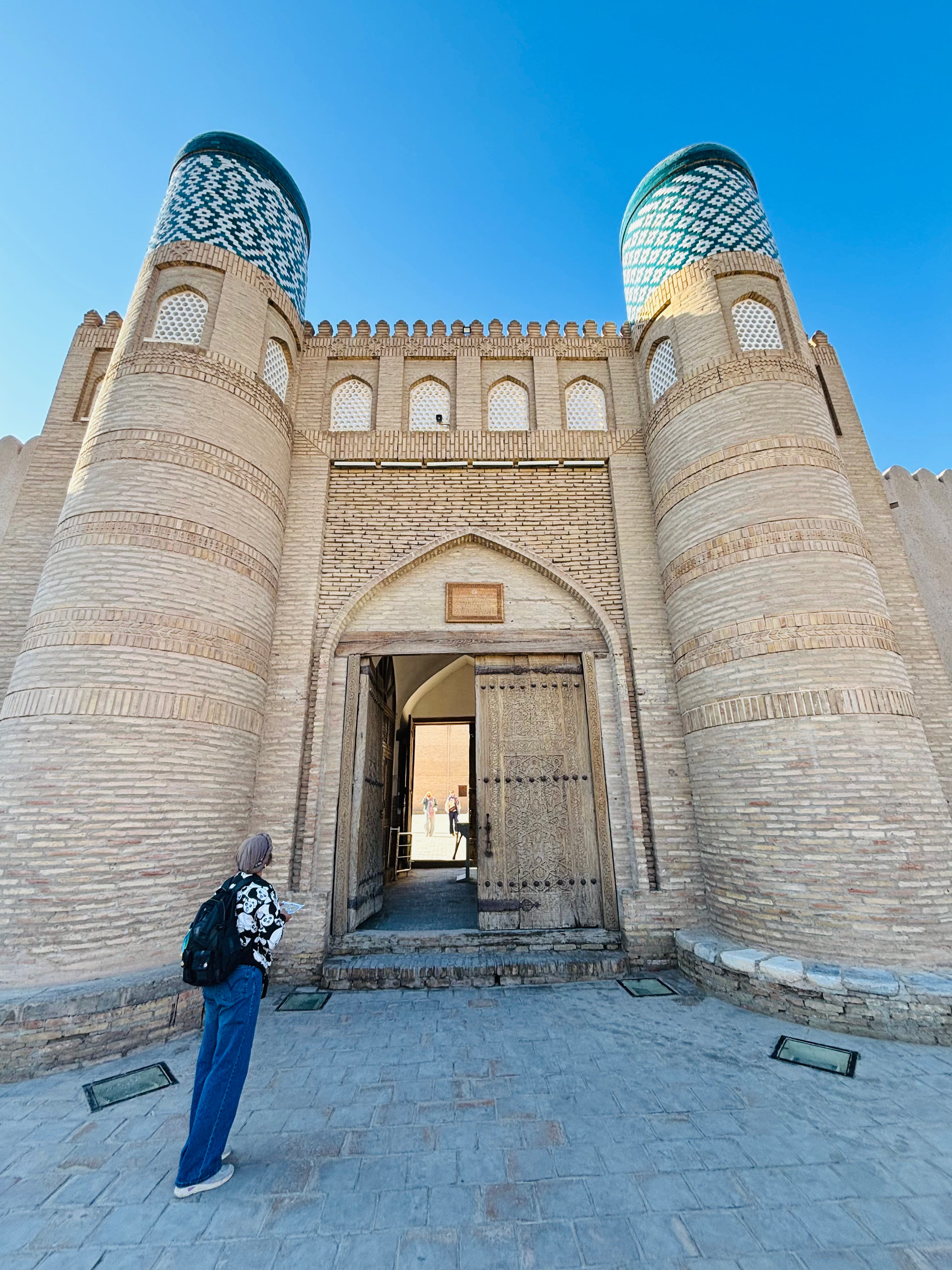
We arrived on the first morning the way one arrives at old things, without agenda, walking slowly, letting the place establish its own tempo. The fortress occupies just over a hectare of the walled city’s western edge, pressed against the ramparts as though the city itself is bracing it from behind. The walls are crenellated, the entrance singular. There is only one way in, and that austerity feels deliberate, the architecture of a ruler who controlled access the way he controlled everything else.
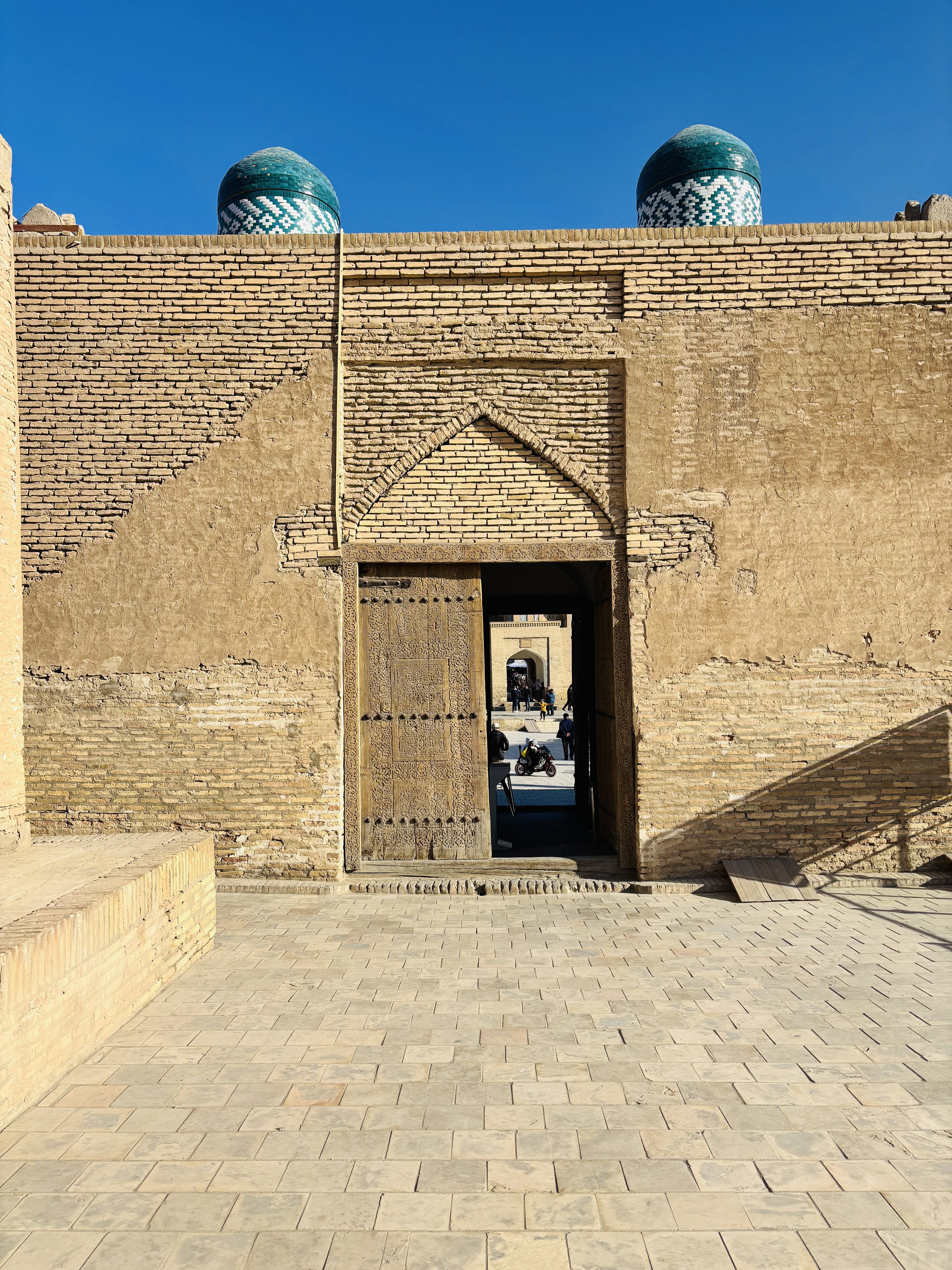
The Ark’s foundations reach back to the fifth century, and some scholars trace a nucleus here as far as the twelfth, but the buildings you move through now are largely the work of the early nineteenth century, built, expanded, and refined by the Qungrat dynasty khans who ruled Khiva from 1804 until the Russians ended the experiment a century later. It is a layered place, each layer visible if you know where to look, and certain layers still revealing themselves. In 2021, archaeologists opened a 584-square-metre excavation on the southeastern flank of the complex, and what emerged confirmed what the old texts had long suggested: that there were once densely packed buildings here too, courtyards where ambassadors waited, yards where cannons were positioned, rooms where the khan’s office hummed with the quiet industry of administration. The earth had held onto all of it.
Tiles, Coins, and the Memory of Sovereignty
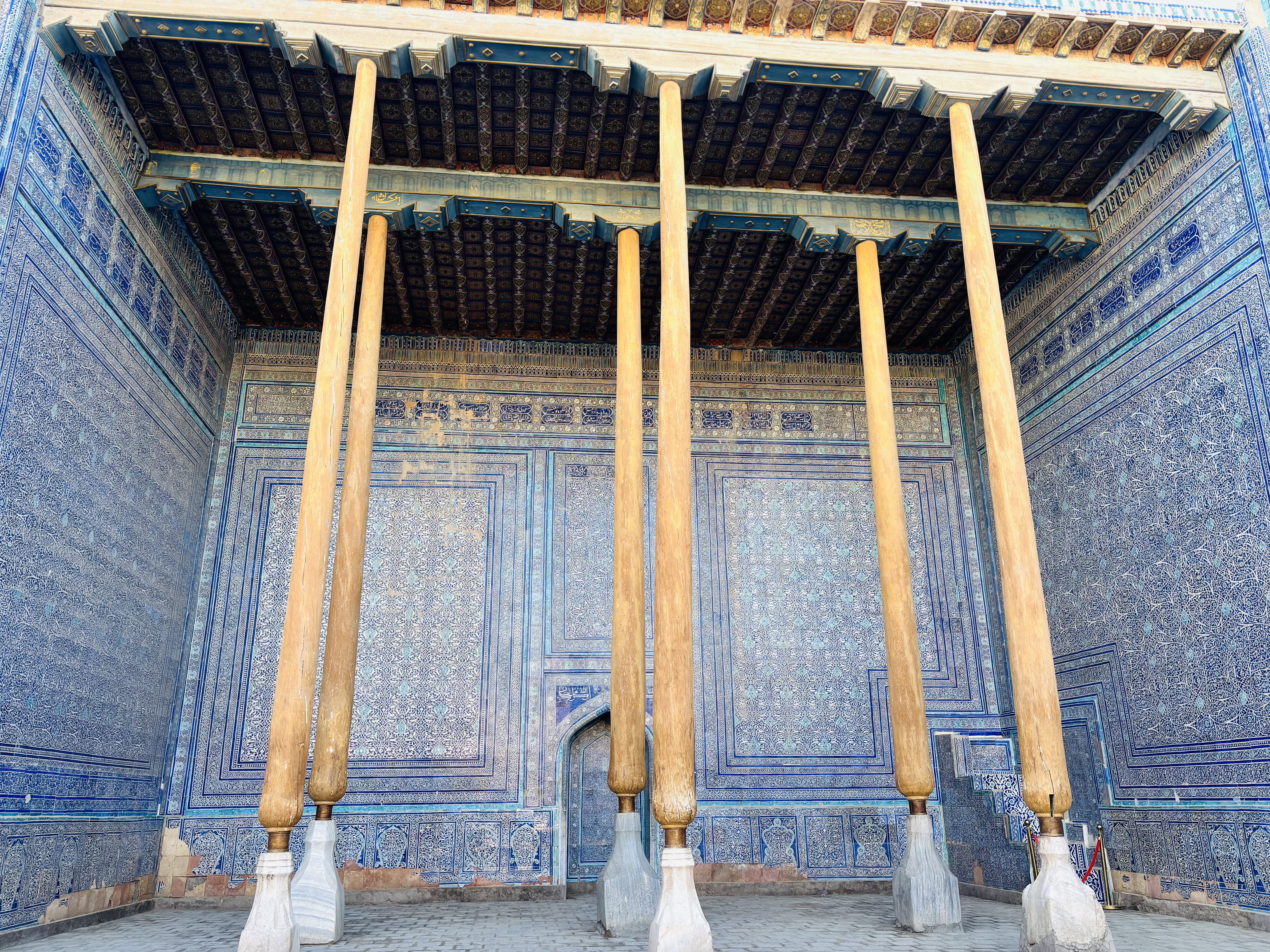
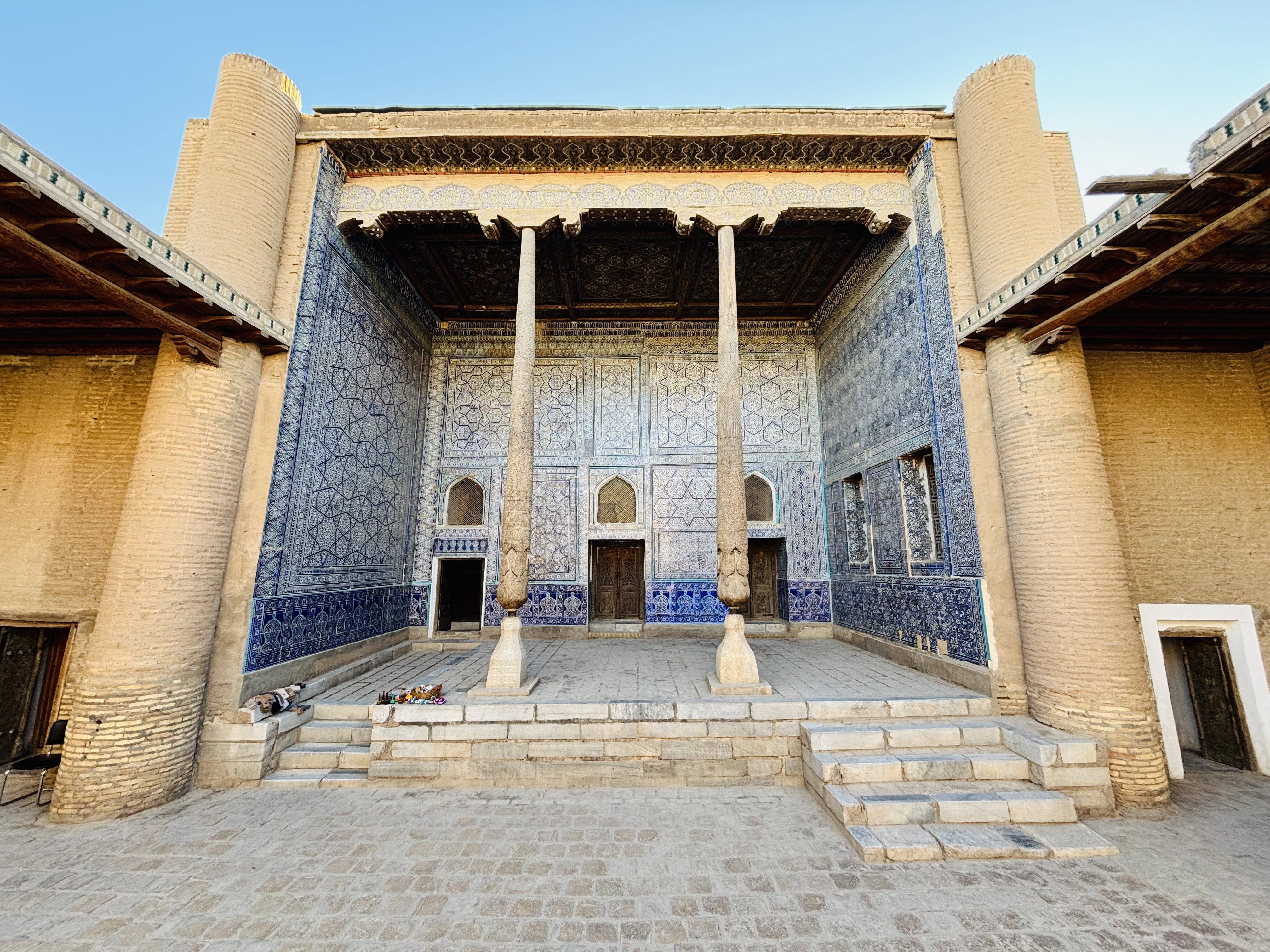
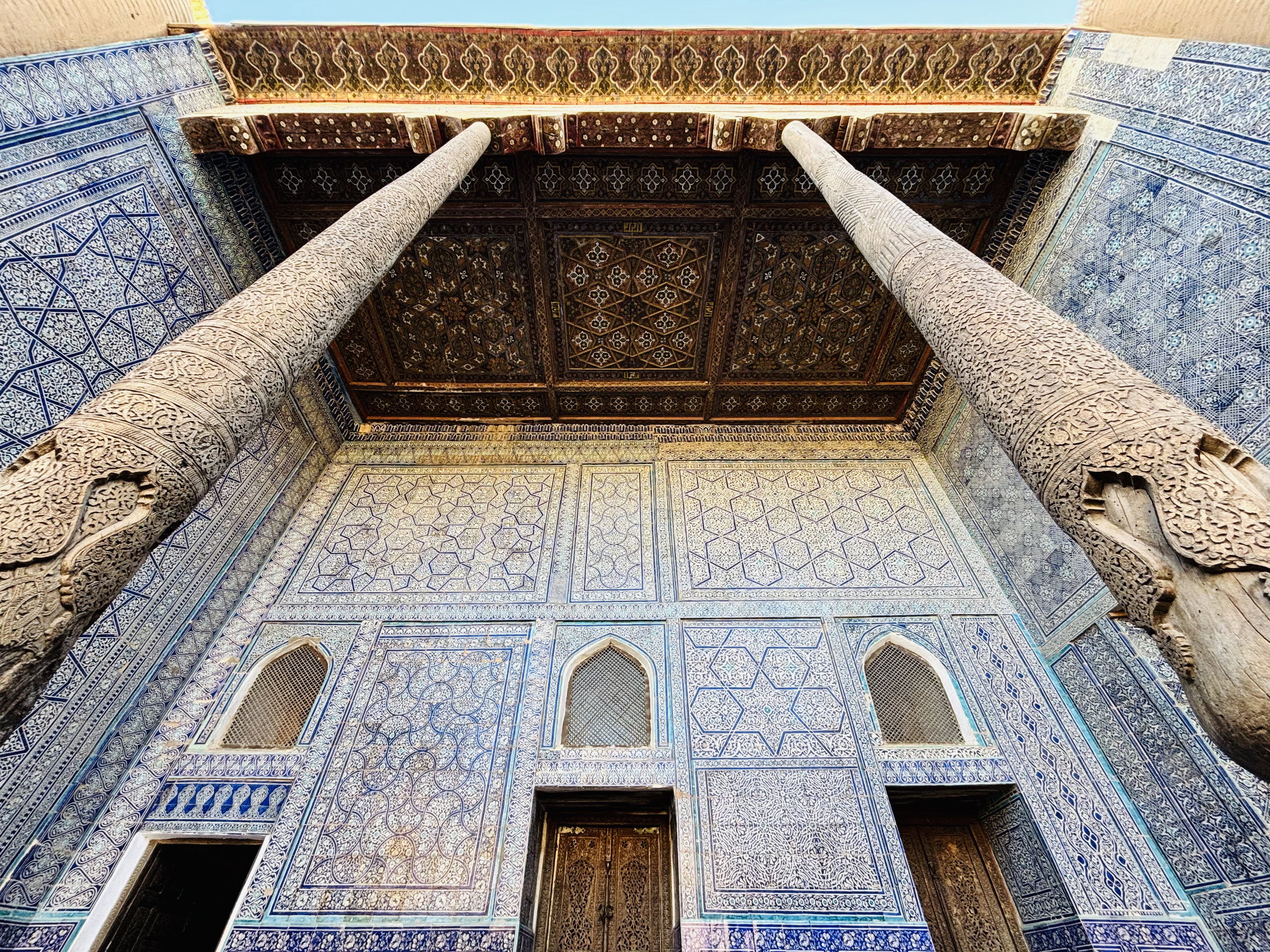
Turn right from the entrance gate and the summer mosque stops you cold. Built in 1838, it is a concentrated burst of blue and white, a north-facing iwan whose majolica tiles seem to radiate rather than simply reflect light. Floral arabesques climb the side walls the way ivy climbs old stone, unhurried and inevitable. The wooden ceiling is picked out in red, orange, gold.
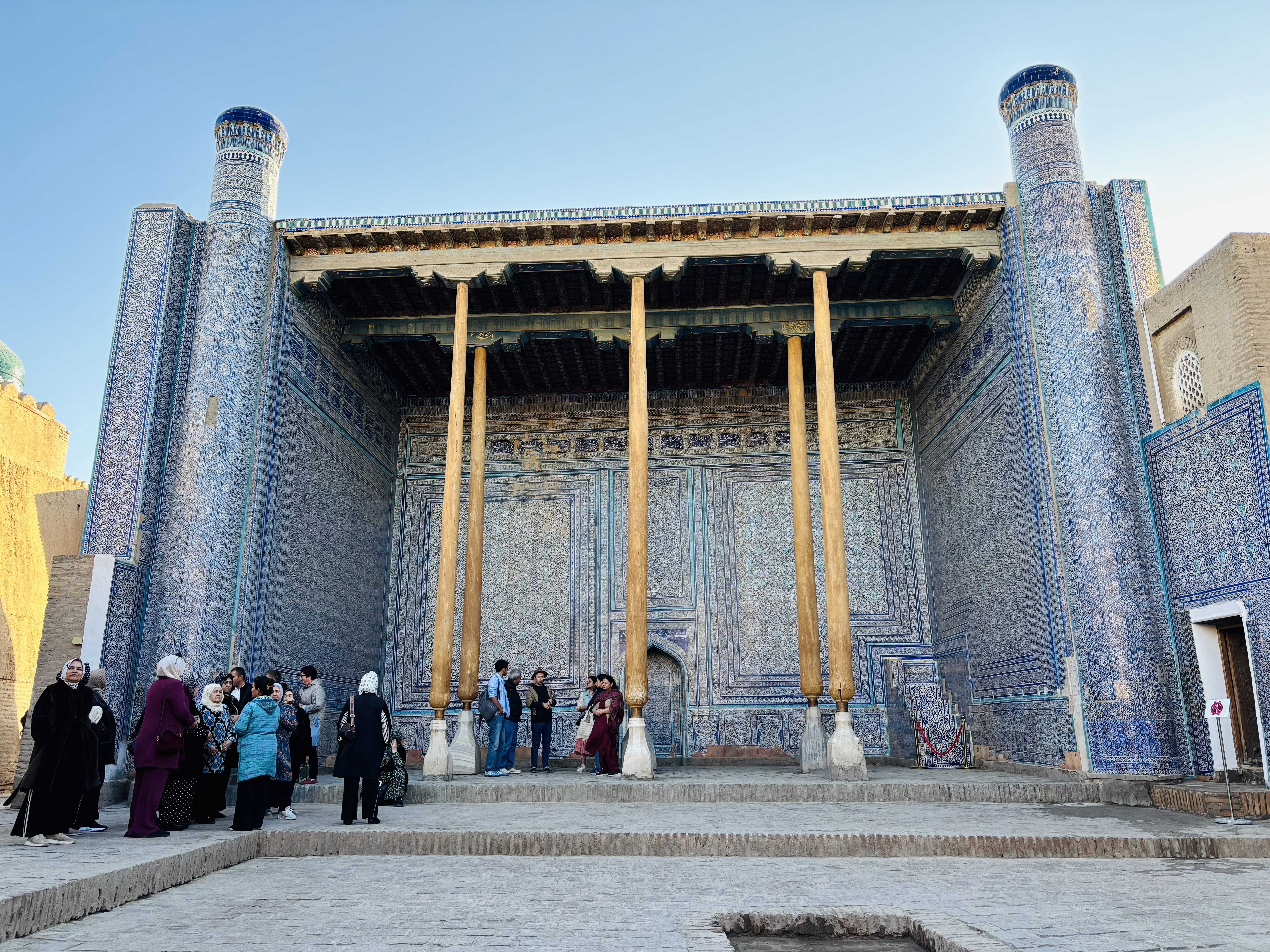
A small blue-tiled mihrab marks the direction of Mecca. The tilework was the work of two local masters, Ibadullah and Abdullah Jin, whose hands also moved across the surfaces of the Tash Hauli and the Pakhlavan Mahmoud Mausoleum, craftsmen who left no biography but left their touch on everything.
Adjacent to the mosque, tucked into the northeast corner of this first courtyard, is the old mint. It was added during the reign of Muhammad Rahim Khan I, the same ruler who consolidated much of what we see today, and it exists now as a small, dense museum of a particular kind of power: the power to make money. Cases hold coins and medals and silk banknotes from the early Khorezm Republic, dawning socialist suns on each face, new iconography layered over old authority. There is a mock-up of a blacksmith’s workshop, the tools of the trade arranged as though the craftsman has just stepped away.
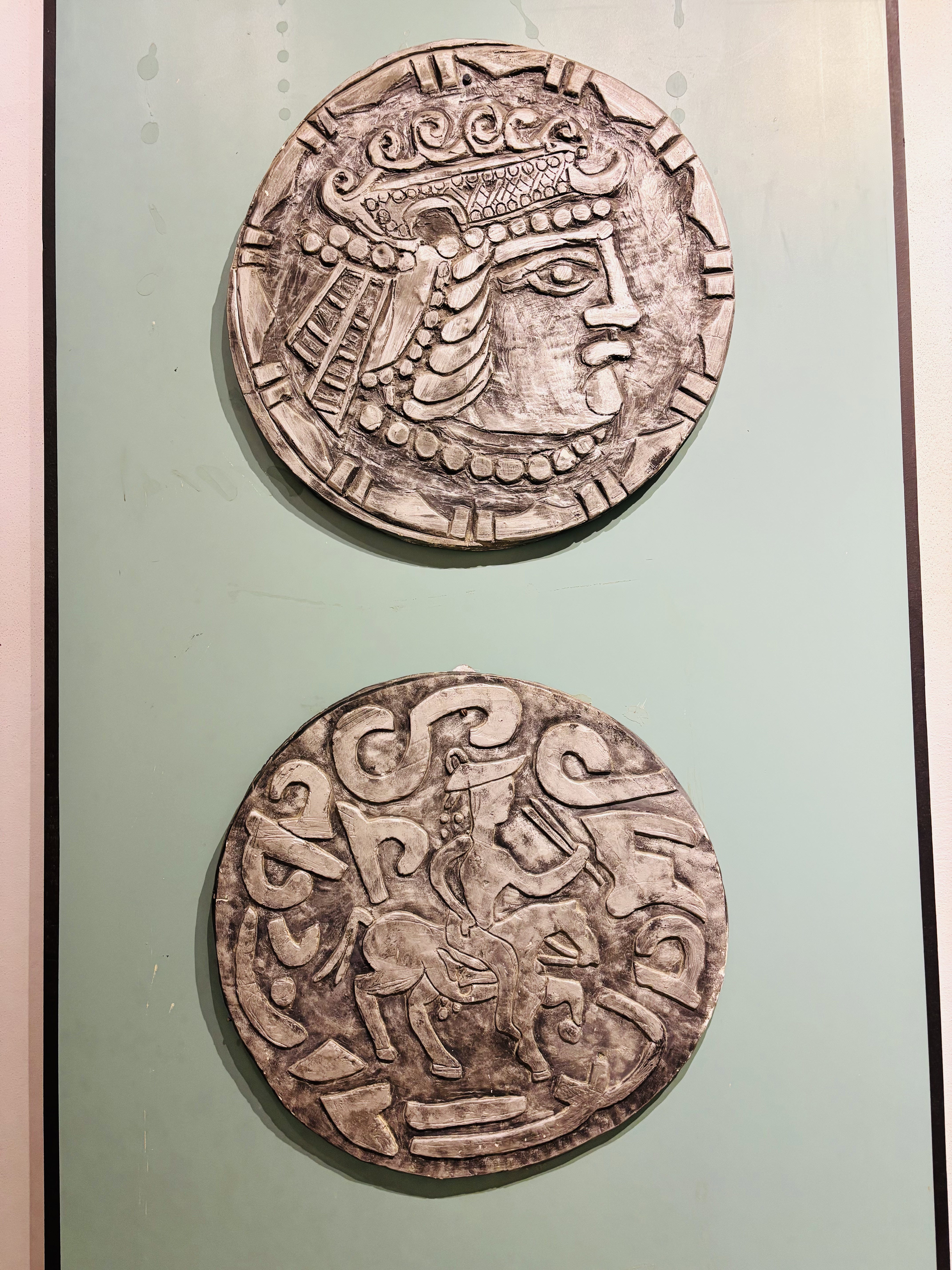
Side rooms open into Khorezmian archaeology: photographs of a mud mask found at Koi Krylgan Kala; the well-worn notebook and battered water bottle of the Russian archaeologist Sergei Tolstov, who spent years mapping the ancient fortresses scattered across the surrounding desert. Objects that carry, in their modest way, entire lives of inquiry.
The Throne That Left and Never Came Back
The deeper you move into the Ark, the more the architecture shifts its register, from the ceremonial to the functional, and occasionally to something that sits uncomfortably between the two. The reception courtyard is the hinge. At its centre stands a raised circular dais, a platform of baked brick, where the khans once rendered judgment from within a tent-like yurt. Around the perimeter ran the rooms of functionaries and advisors, the administrative machinery of a khanate. The iwan here mirrors the mosque’s in form, though stripped of its mihrab, authority without devotion, or at least with devotion expressed elsewhere.
Behind the iwan lies the Throne Room, dating from 1804 to 1806, used primarily through the winter months. Its ceiling decoration is fine, its geometric tilework precise, its ganch plasterwork worked with the focused attention of craftsmen who understood that even private rooms carry their own weight. It was in this room that Captain Muraviev of Russia was finally granted an audience with the khan, after seven weeks of deliberate uncertainty during which his fate was never quite settled. He was made to wait long enough to understand exactly where power resided.
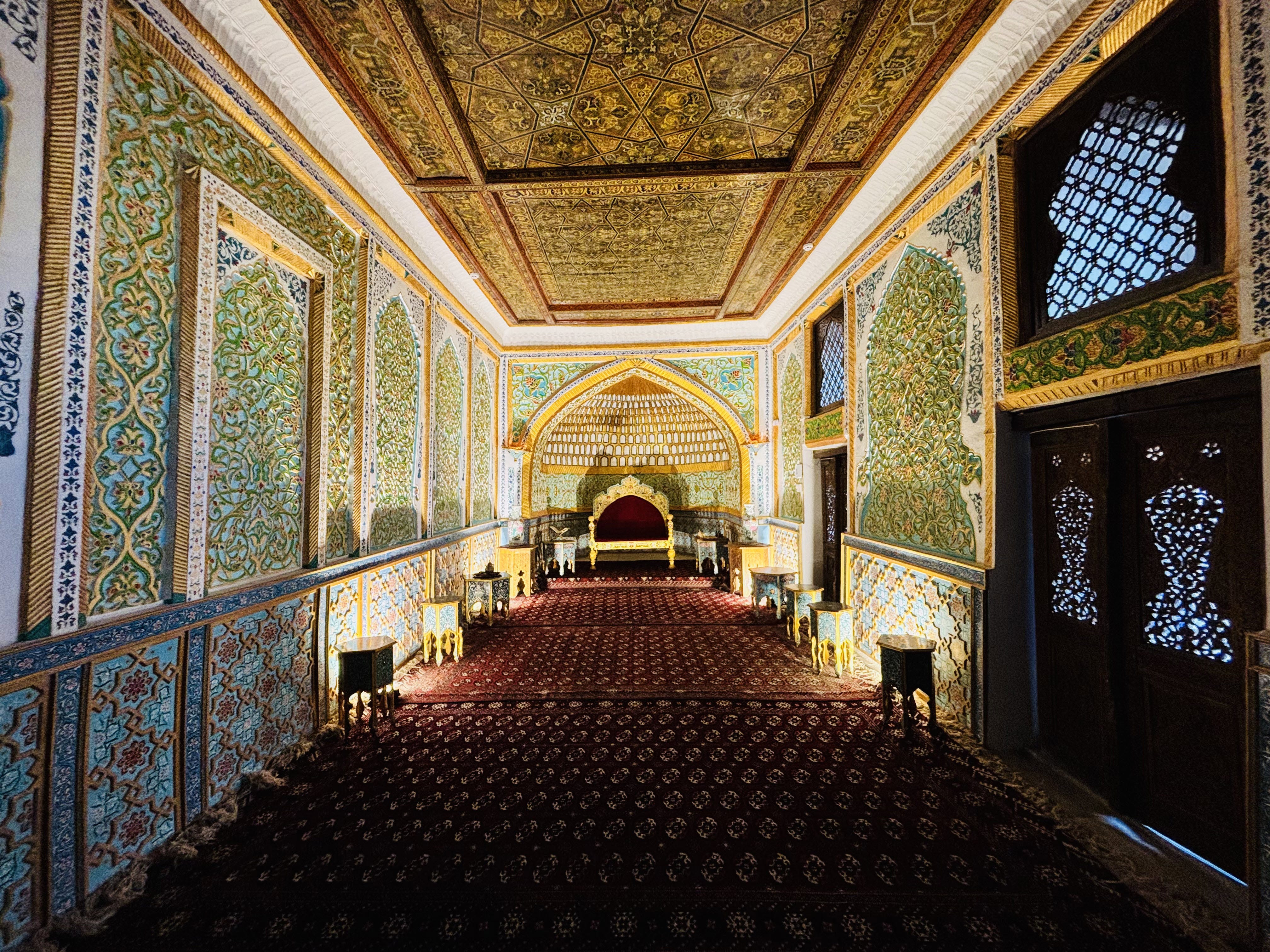
The throne itself, built in 1816, gilded in silver, is no longer here. The victorious Russians carried it off to the Hermitage in St. Petersburg, where it has remained ever since. Negotiations for its return continue, though they have not yet succeeded. This is a recurring condition in Khiva: the most significant objects are often elsewhere, and their absence is itself a kind of presence. The Arab Mohammed Khan Madrassah nearby holds some 55,000 objects taken or purchased from local people in the 1920s. The collection exists; the context it was removed from does not quite recover.
What the Stones Remember
The 2021 excavations on the southeastern side of the Ark opened a window into the fortress’s deeper past. At the highest layers, closest to the surface, closest to the last period of occupation, archaeologists found the foundations of a brick building running north to south, a floor of fired brick alongside it, and a tashnov, a drainage channel, set into the middle. The ceramics here dated to the nineteenth century: khums, jugs, bowls in the styles of the late khanate period, exactly as the historical sources had described.
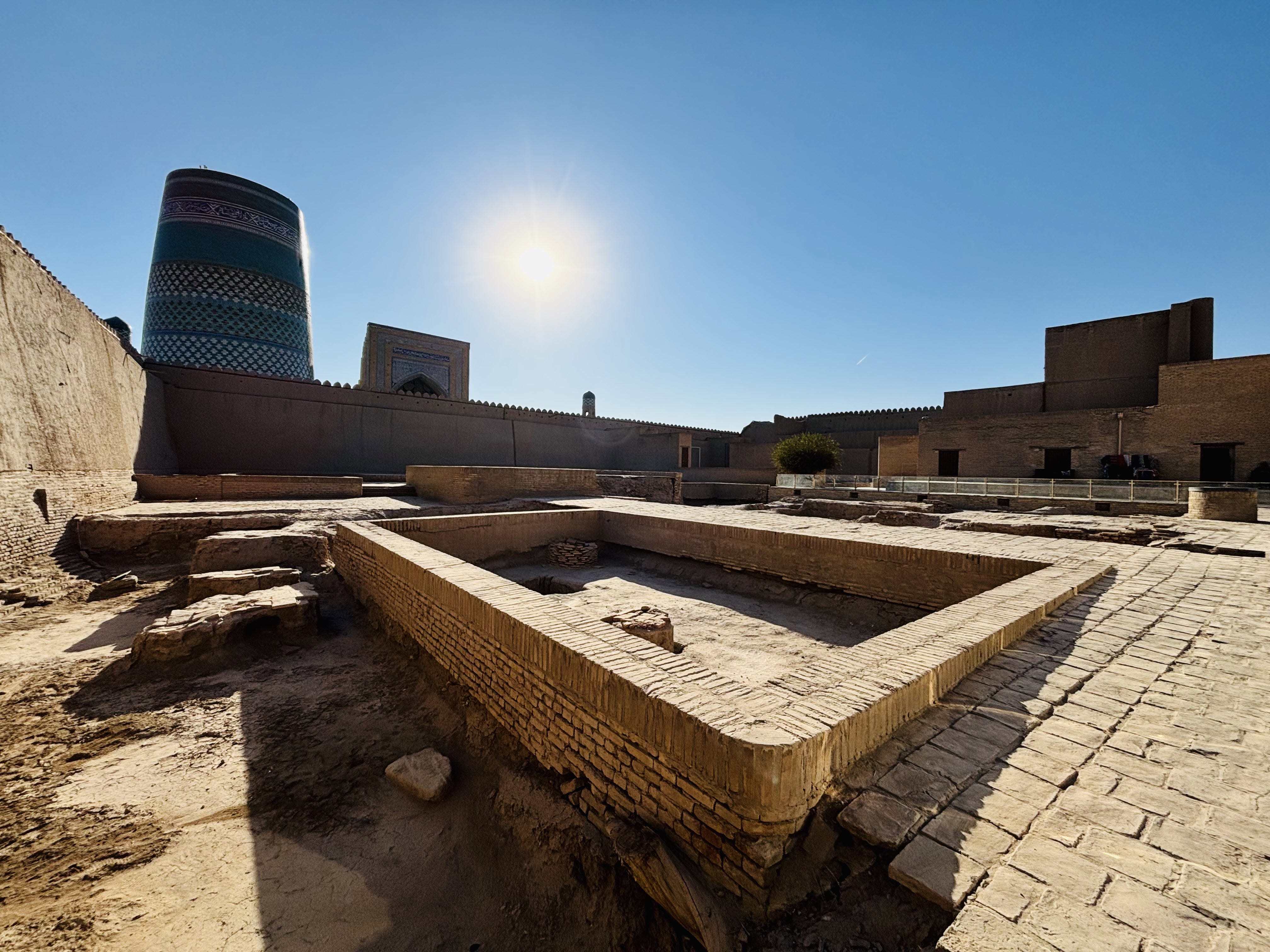
Dig deeper and the centuries shift. At a depth of around a metre and a half, a well appeared, circular, built of fired brick, its associated floor still visible, dating to somewhere between the sixteenth and eighteenth centuries. Pottery continued: glazed and unglazed, still speaking of daily life in all its ordinary detail. But at two to three metres, in a trench opened on the western side of the site, the clay changed character entirely. Gray, unglazed, decorated with incised patterns, and the ceramics here, by the method of their making and the composition of their clay, belonged to the thirteenth and fourteenth centuries. A rectangular hearth was uncovered at this level, used for economic rather than ceremonial purposes: people cooking, working, heating. The earliest sediment of ordinary life.
To stand at the edge of such an excavation is to feel time not as abstraction but as physical depth. Each layer is a floor that someone once walked across, a pot that someone once filled with water, a fire that someone once lit for warmth. The city of Khiva carries 2,500 years of continuous habitation, and somewhere below the surface of this particular courtyard, all of those centuries are still stacked, one atop the other, waiting.
Justice of a Different Kind
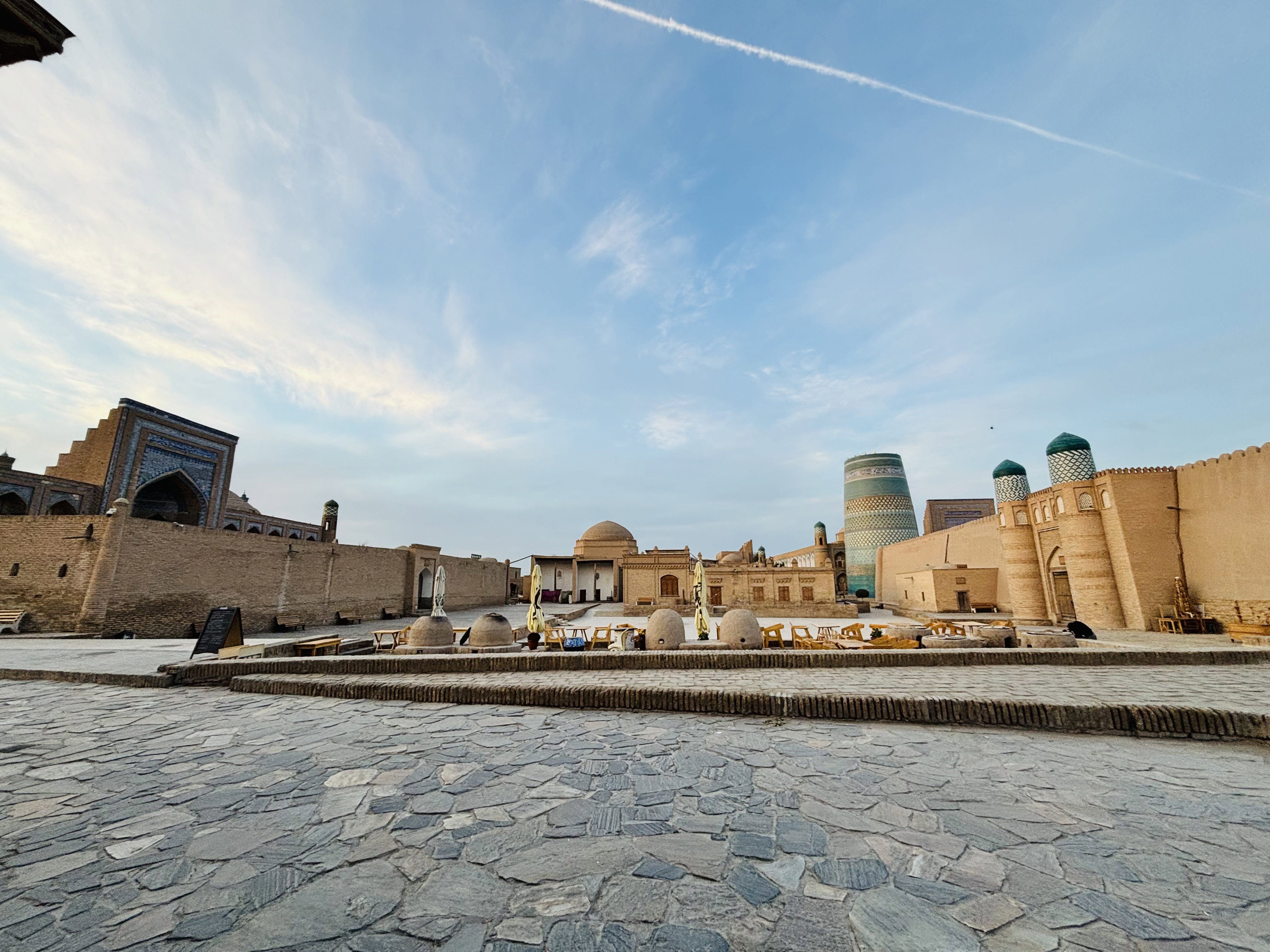
Just outside the Ark’s main entrance, to the south and still within the Ichan-Kala’s walls, stands the zindan, the city jail. It is the most recent of the Ark’s associated structures, built in 1910, barely a decade before the Russians finally dissolved the khanate. Its equipment, manacles, flails, illustrated panels depicting executions, leaves very little to imagination, and does not intend to.
The square in front of the zindan was, in the khanate’s later centuries, a space of public reckoning. The Hungarian traveller Arminius Vámbéry passed through Khiva in 1863 and witnessed executions he could not afterwards set aside: men blinded in sequence on the ground, the executioner moving methodically from one to the next, wiping his knife on the white beard of each victim as he finished. What disturbed him most, he wrote, was not the cruelty itself but the normalness of it, the way usage, law, and religion all conspired to make it unremarkable. Wanton cruelty, he insisted, was in fact unknown in Central Asia; the proceedings were simply regarded as natural, which was somehow a more unsettling observation than the acts themselves.
The British officer Frederick Burnaby, riding through the region a decade later, had a more measured encounter with Khivan justice. He visited the gardens south of the city, where the khan held summer court on an open stone dais, and inquired about the judicial system. The answers he received were candid: if a man denied guilt and swore on the Koran with no witnesses against him, he went free, the Khivans trusting in Allah’s vengeance to settle the matter eventually. If witnesses existed and the accused still refused to confess: we beat him with rods, put salt in his mouth, and expose him to the burning rays of the sun until he confesses. This was offered without apology, as procedural fact. In the jail itself, Burnaby found two prisoners in wooden stocks, iron chains around their necks, accused of assaulting a woman but unwilling to confess. They would wait until they did.
The zindan today does not require much imagination to inhabit. It holds its history with a directness that the gilded throne room does not.
From the Bastion: A City Laid Bare
We returned the following morning for the Ak Sheikh Bobo bastion, the fortified heart of the Ark, integrated into the western city wall, reached by a curving staircase that ascends in near-darkness. This is the oldest section of the Kuhna Ark, its foundations contemporary with the great desert citadels of ancient Khorezm, Toprak Kala and its vanished siblings, that have been receding into the sand for centuries. Those fortresses died of abandonment; the Khivan heart survived and accumulated.
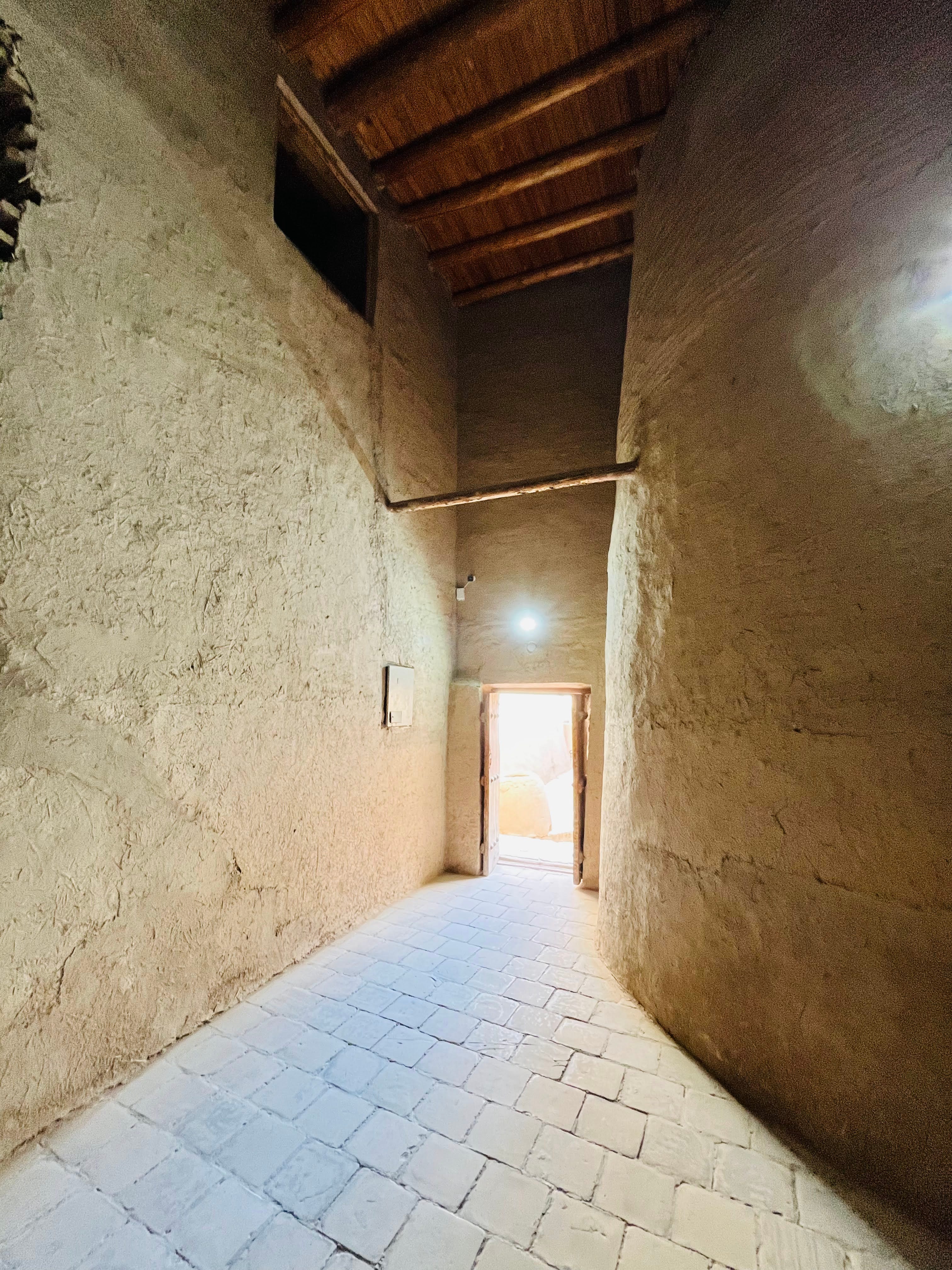
The bastion had served, over its long life, as hermitage for Mukhtar Vali, the White Sheikh, whose memory still pools in the city’s sacred geography, and later as watchtower, and later still as gunpowder arsenal. Contradictory uses for a single structure, which is perhaps the point: the Ark’s oldest precincts had to be many things to many rulers, accommodating devotion and ordnance with equal indifference.
At the top, the platform opens, and the city opens with it. The Ichan-Kala spreads below in every direction, its minaret needles, its mud-brick rooftops, its domes turning from grey to gold as the October light shifts. The harem courtyard lies directly below, its interior now visible in a way that makes clear this vantage point was not for ordinary use. Trusted watchmen only, we are told. The geometry of the city’s streets becomes legible from here in a way it never quite is on the ground: the mosque alignments, the Ark’s own rooflines, the long shadow of the city wall sweeping west and south.
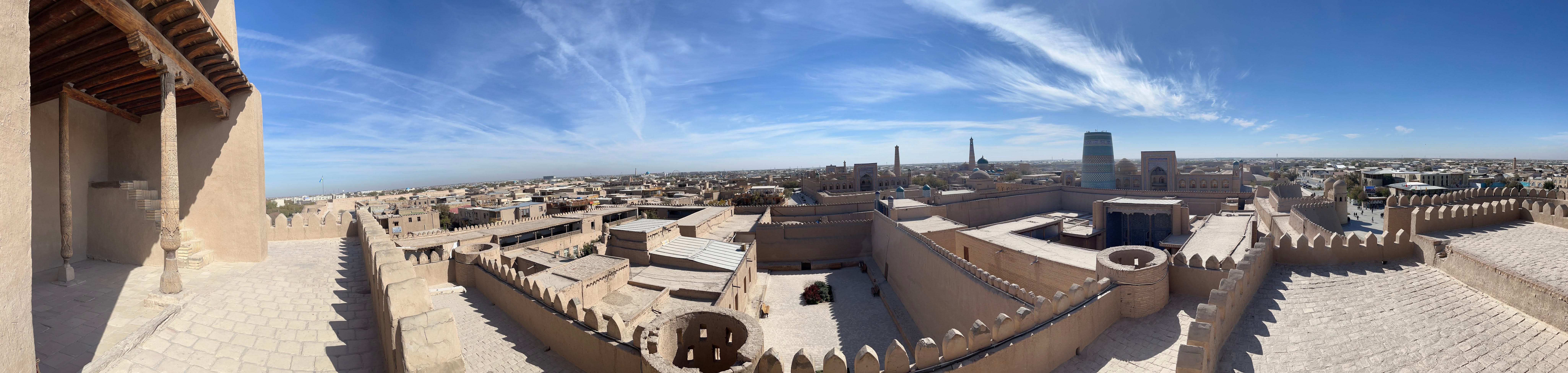
Somewhere beneath the platform, in the lower halls of the bastion, there is near-darkness. But on the platform itself, in the October air, with the light doing what Central Asian light does in the hour after dawn, Khiva makes complete sense, not as a historical problem to be solved or a political entity to be assessed, but as a human achievement: a city that people built, and kept building, and defended, and expanded, and lost, and partly recovered, and are still, in their way, making sense of.
The Heaviness of What Remains
We left the Ak Sheikh Bobo bastion as the sun had fully cleared the horizon and the city below had begun its morning business, vendors opening stalls, tourists arriving in the first coaches, the ordinary machinery of a place that has learned to live with being visited.
The Kuhna Ark resists the category of monument. Monuments are finished things, sealed off and interpreted. The Ark is still porous: an excavation on its southern flank still being measured and mapped, a throne absent from a room that remembers it, negotiators in Tashkent and St. Petersburg still circling an unresolved question. The tiles remain, Ibadullah’s and Abdullah Jin’s arabesques still climbing those walls after two centuries, but the institution that commissioned them is gone, its justice both terrible and, in its own logic, coherent, its sovereignty documented in coins that the mint no longer strikes.
What stays with you, walking out through that single east-facing gate, is a particular weight, not the weight of tragedy exactly, but of accumulation. Fifteen centuries of layered occupation, most of it invisible above ground but present below; throne rooms and harems and excavated hearths; a blinded man groping for his feet in Vámbéry’s unforgettable account; a prisoner in stocks waiting for an admission he cannot bring himself to make. All of it absorbed by the same thick walls, stored alongside the gunpowder in the bastion’s dark lower chambers.
Khiva knows how to hold things. The Kuhna Ark knows how to hold them longest.
These are such modern, minimal structures, but with a lot of character and intricacies. Unlike stark modern minimal, brutalist architecture that we see today.